
Own assembly of modular conveyor belts
TD "IRBIS" LLC carries out in-house assembly of modular conveyor belts for industrial enterprises that need a reliable solution for a specific conveyor, operating conditions and production load. We help select, assemble and prepare the belt for operation, to reduce equipment downtime and raise the stability of the production process.
What assembly of modular conveyor belts includes
Assembly of modular conveyor belts includes not only the mechanical joining of individual modules but also a preliminary analysis of the conveyor's operating conditions, the type of product and the operating requirements. This approach lets us select a belt that suits the operating conditions, reduces the risk of premature wear and ensures stable operation of the production line.
Selecting a modular belt for the operating conditions
Before assembly, our engineers analyze the conveyor type, loads, speed of travel, temperature conditions, the effect of moisture, the type of product and sanitary and hygienic requirements, as well as the effect of abrasive materials and other production factors. This lets us select the optimal module type, belt pitch, material and design.
Assembling the belt to the required size
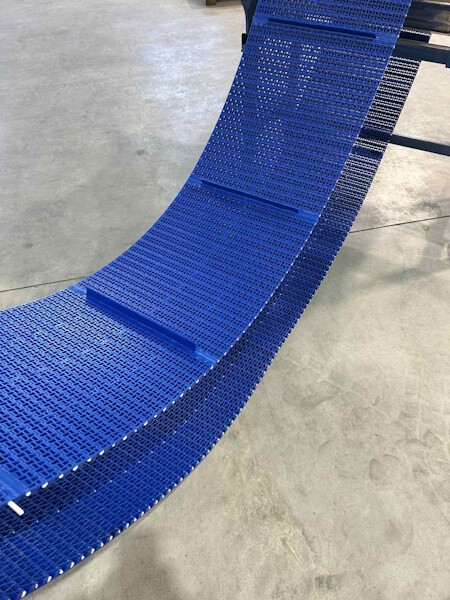
A modular conveyor belt is assembled from individual sections that are joined together into a web of the required length and width. Where needed, sidewalls, flights, drive features, the tensioning method and other parameters of the specific line are taken into account.
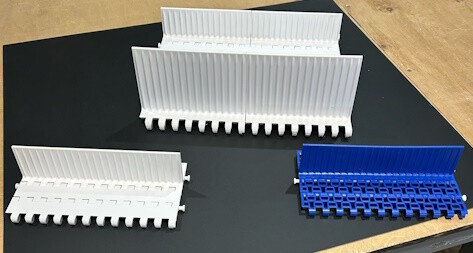
Modular conveyor belt assembly services
-
Assembly of modular belts for straight conveyors - preparing belts for standard transport lines, taking into account width, length, speed and product type.
-
Assembly of belts for food production - selecting solutions that meet the requirements of hygiene, easy cleaning and stable operation in a wet environment.
-
Assembly of belts for heavy-duty conditions - solutions for enterprises where the belt works with high loads, high speeds, frequent start cycles or abrasive materials.
-
Selection of an alternative to a worn belt - identifying the old belt from a sample or operating conditions and selecting a modern equivalent.
-
Preparation of belts with non-standard parameters - assembly of a web for the special requirements of a production line, when a standard solution does not give the required result.
Stages of ordering assembly of a modular conveyor belt
-
Collecting initial information. At the first stage we clarify the type of equipment, belt dimensions, operating conditions, the nature of the load, travel speed and the reason for replacement or modernization.
-
Analysis of the technical specification. IRBIS engineers check which solution will be optimal by price, quality, availability and service life. If there is no technical specification, we help draw one up.
-
Selection of components. Modules, connecting elements, sprockets, guides and additional elements are selected, if they are needed for stable operation of the conveyor.
-
Assembling the belt. The modular belt is assembled to the agreed parameters.
-
Handover to the customer and recommendations. After the work is done, the customer receives the finished belt and recommendations on installation, tensioning, maintenance and further trouble-free operation.
Why order assembly of modular belts from IRBIS
-
Engineering approach - we do not just assemble a belt, we select a solution for a specific conveyor and production process.
-
Experience in the B2B segment - the team works with enterprises in different sectors of the Ukrainian economy and understands the requirements of industrial operation.
-
Cost optimization - we help select components with a rational balance of price, quality and availability.
-
Less downtime - a correctly selected and assembled belt helps reduce the risk of emergency stops and repeat replacements.
What you get after modular belt assembly
-
A finished modular conveyor belt, assembled to the parameters of your equipment.
-
A solution that takes into account the load, the operating environment and the specifics of the product.
-
Recommendations on installation, operation and extending the service life of the belt.
Which equipment needs assembly of modular conveyor belts
Modular belts are used on conveyors that move products, raw materials, containers, packaging, semi-finished or finished goods. Such belts are especially relevant where resistance to moisture, regular cleaning, frequent starts and stops, and stable web geometry are needed.
Assembly of a new modular belt is needed if the old belt has cracks, broken modules, stretching, skewing, damaged joints or does not give the required productivity. The service is also relevant when modernizing a conveyor, changing to a different type of product, or changing the line's operating mode.
Which problems assembly of a modular belt helps to solve
A correctly selected and assembled modular belt helps eliminate typical problems of conveyor equipment: unstable movement of the web, frequent wear, slipping, damage to products, difficulty of sanitary treatment or a belt that does not match the actual loads.
The main tasks the service solves:
-
replacing a worn or damaged belt;
-
selecting an alternative when markings or documentation are missing;
-
adapting the belt to new operating conditions;
-
improving the reliability of transportation;
-
reducing maintenance and emergency repair costs.
The IRBIS team can analyze the existing problem at your enterprise, collect the necessary information and propose a solution that is technically grounded and convenient for further operation.
Which enterprises the service suits
Modular belts are assembled mainly for manufacturing, processing, packaging, agricultural, food, logistics and other enterprises where the conveyor line directly affects the stability of the process. The service is relevant both for planned replacement of a worn belt and for quickly getting equipment working again after damage, a change of product or an update of the production line.
It is especially useful for enterprises that want to standardize spare parts, reduce warehouse stock, switch to more affordable components or replace a belt that the manufacturer no longer supplies.
Approximate timing of the work
The time to assemble a modular conveyor belt depends on its width, length, the type of modules, the availability of components and the complexity of the technical specification. For standard solutions the work can be done faster, even on the day you get in touch, especially if all the equipment parameters are already known.
If identification of an old belt, selection of an equivalent, an engineer's visit or the development of a non-standard solution is needed, the timing is agreed individually. This approach avoids mistakes and gives a belt that really fits the production conditions.
Order assembly of a modular conveyor belt from IRBIS
Contact TD "IRBIS" LLC if you need to replace a worn belt, select an equivalent, prepare a solution for a new conveyor or modernize an existing transport line.
Our engineers will help determine the optimal parameters and select components taking into account your enterprise's tasks.
FAQ
When should you order a new modular belt?
A new belt should be ordered when there is wear, broken modules, unstable web movement, frequent line stoppages or a change in production conditions. The service is also needed when modernizing a conveyor.
By which parameters is a modular conveyor belt selected?
A modular belt is selected by width, length, module pitch, type of material, load, travel speed and operating conditions. The type of product, the conveyor design, sprockets, guides and the line's operating mode are also taken into account.
Which factors affect the service life of a modular conveyor belt?
Service life is affected by how correctly the belt is selected, the load, travel speed, temperature, humidity, abrasiveness of the product, the condition of sprockets and guides, and correct installation. Regular maintenance and timely correction of skewing are important.
Can a modular belt be adapted to non-standard operating conditions?
Yes, a modular belt can be assembled for specific operating conditions: a wet environment, frequent washing, high loads, an inclined conveyor, contact with food products or non-standard line geometry. The parameters are agreed after the task is analyzed.
How long does it take to assemble a modular belt?
The time depends on the size of the belt, the complexity of the design and the availability of components. After the conveyor parameters are clarified, the IRBIS team agrees realistic lead times with the customer. In some cases production on the day of the request is possible.